

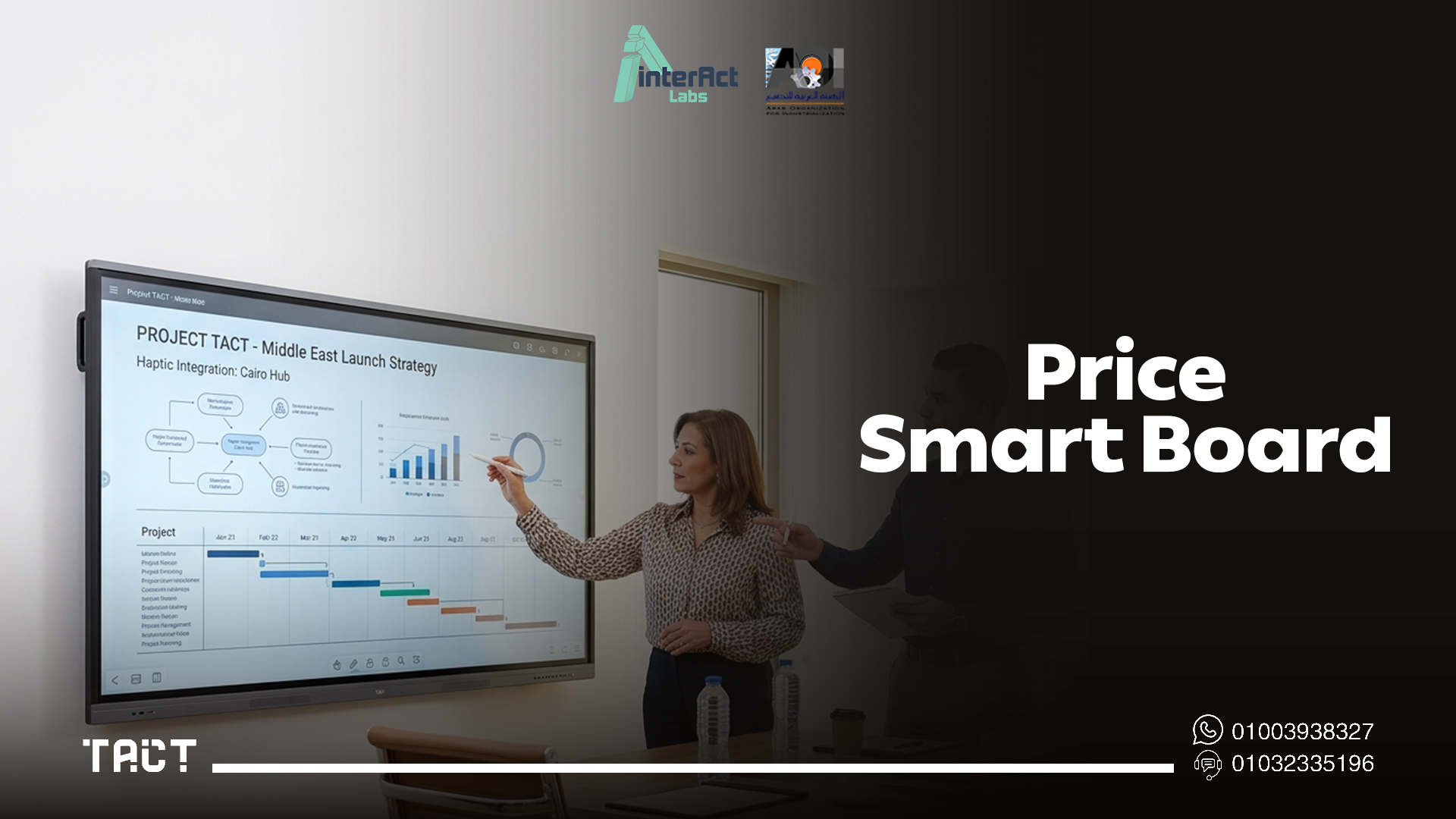
Comparing smart board prices without understanding what drives them is how schools and businesses end up overpaying — or underpaying for something that won't hold up.
Smart board price isn't a single market rate. It's a spectrum, and where a product sits on that spectrum depends on a specific set of technical and operational factors. Understanding those factors is what separates a smart purchasing decision from an expensive mistake.
This guide breaks down exactly what determines smart board price in the current market, how to evaluate what you're actually getting for the cost, and where alternatives like the Tact device deliver genuine ROI without the full price tag.
Evaluating interactive solutions for your school or business? Visit Interact Labs and compare options built for the Egyptian market.
What Actually Determines Smart Board Price

Two smart boards can look similar in a product listing and differ by tens of thousands of pounds in price. The gap is rarely arbitrary — it comes down to specific technical and operational variables that directly affect performance, longevity, and total cost of ownership.
Screen size and display area
Larger screens cost more — not just because of material costs, but because larger displays require more precise manufacturing tolerances to maintain consistent touch accuracy across the full surface. A 65" board and an 86" board aren't just different in size; they represent meaningfully different engineering challenges, which the price reflects.
For practical purposes, the right size depends on the room. A larger screen in the wrong space doesn't add educational value — it adds cost without proportional benefit.
Display resolution
Full HD and 4K displays command higher prices because they require more advanced panel technology and more processing power to render content at high resolution in real time. For classrooms where text-heavy content needs to be readable from the back of the room, resolution is a genuine performance variable — not just a marketing specification.
Touch technology and response accuracy
Multi-touch capability — the ability for multiple users to interact with the screen simultaneously — adds complexity and cost to the touch sensing layer. Fast response times and precise pen tracking require calibration systems that vary significantly in quality between price tiers. In practice, this is one of the variables where cheaper smart boards show their limitations fastest: lag, drift, and inaccuracy under heavy use.
Built-in operating system and software
Smart boards with integrated operating systems — Android, Windows, or both — eliminate the need for an external computer to run basic functions. This adds to the upfront price but reduces the total setup cost by removing a hardware dependency. The value of this feature depends entirely on how the board will be used: for schools that need a self-contained classroom solution, it's worth the premium; for institutions that already have computers in every room, it may not be.
Connectivity options
HDMI, USB, Wi-Fi, Bluetooth, and wireless screen mirroring each add to the hardware complexity and the price. The relevant question isn't which board has the most connectivity options — it's which options the specific use environment actually requires. Paying for wireless mirroring in a room that will always use a cable connection is paying for unused functionality.
Build quality and durability
Material quality affects both longevity and daily experience. A board built for high-frequency classroom use in an Egyptian school — where a device may run six to eight hours daily for years — needs to be engineered differently from a device intended for occasional corporate meeting room use. Build quality is one of the areas where imported smart boards frequently disappoint: designed for controlled environments, underperforming in intensive daily use.
Brand and after-sales support
A portion of every smart board's price reflects the manufacturer's support infrastructure. Extended warranties, local technical support, training, and spare parts availability are real value — but only if they're actually accessible in the local market. An international warranty that requires overseas coordination to activate has a very different practical value than local support with an actual response time.
Smart Board Price vs. Real Value: How to Evaluate ROI
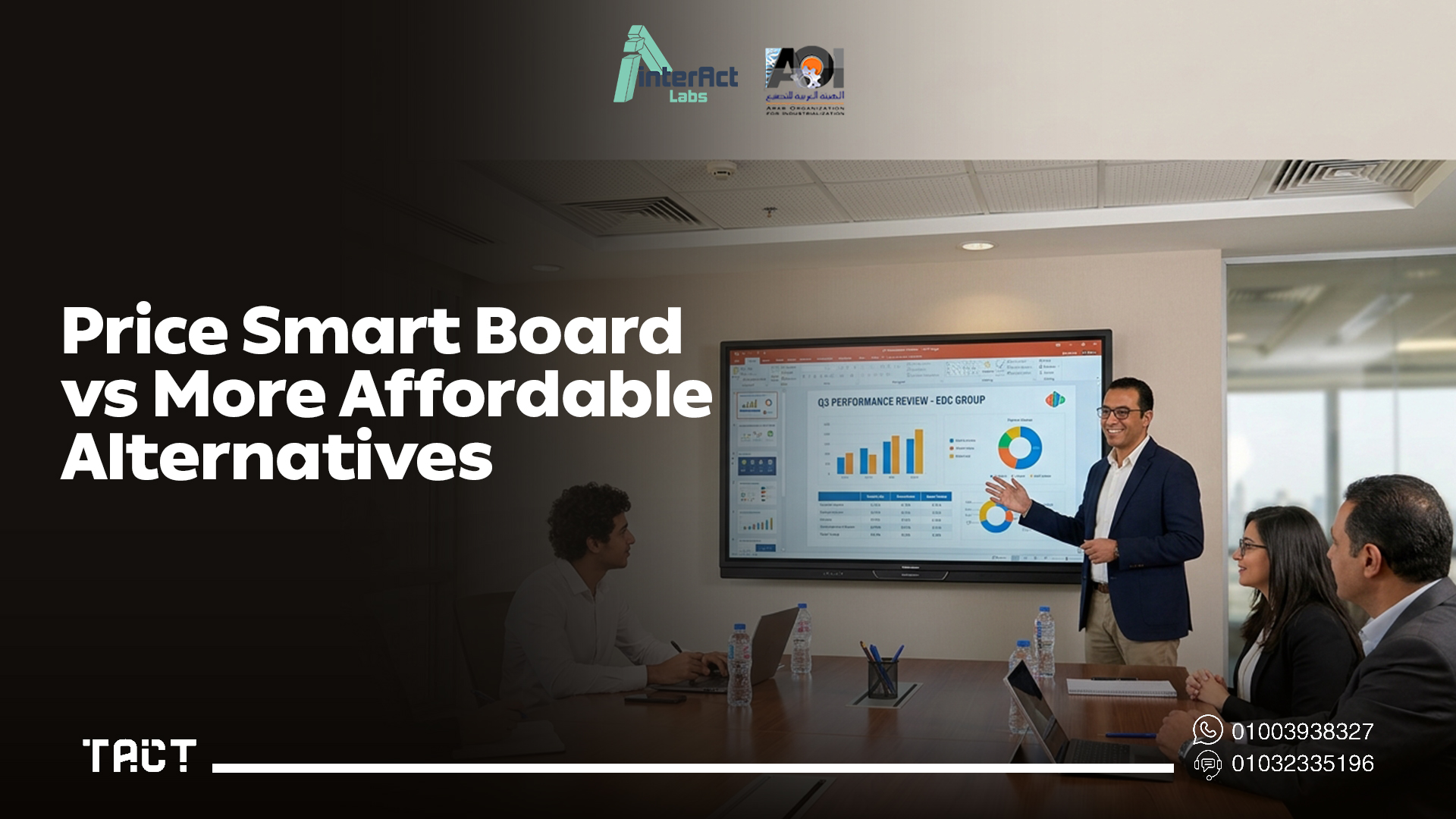
The most useful framework for evaluating smart board price isn't cost comparison — it's return on investment over a realistic usage period.
Three questions define the ROI calculation:
How many rooms does the investment cover? A single smart board at full price equipped one room. A solution that costs 20% of that per room equipped five. For schools with multiple classrooms, the multiplication effect matters more than the per-unit price.
What are the ongoing costs after purchase? Maintenance contracts, software licenses, spare parts, and eventual replacement all add to the total. A lower upfront price paired with high ongoing costs can easily exceed the total cost of a premium product over five years.
What functionality does the actual use case require? A 4K display with multi-user touch and a built-in OS delivers full value in a university lecture hall. In a small private tutoring room with ten students, it's significantly more than what the use case demands. Matching specifications to requirements — not buying the most advanced option available — is what produces genuine ROI.
Where the Tact Device Fits in the Smart Board Price Landscape
The Tact device occupies a specific and deliberate position in the smart board price landscape. It's not a budget smart board — it's a different category entirely.
Rather than competing on display specifications or built-in features, it solves the price problem from a structural angle: it adds interactive functionality to whatever display the school or business already has, eliminating the hardware replacement cost entirely.
See the Tact device specifications and pricing — and compare against full smart board system costs.
For an institution with existing monitors or projectors, the ROI calculation changes completely. The hardware investment already made continues to deliver value. The per-room cost drops to a fraction of a full smart board purchase. And the functionality delivered — writing, annotation, real-time interaction with displayed content, lesson saving and sharing — covers the core requirements of interactive teaching and presentation.
The Tact device makes most practical sense in three scenarios: schools needing to equip multiple rooms within a fixed budget, institutions that already have functional displays and don't need to replace them, and environments where portability between rooms is more valuable than a fixed high-spec installation.
Tact Device: Key Value Factors
One-time cost structure No recurring licensing fees, maintenance contracts, or mandatory updates. The cost is paid once at purchase — and that's where the financial commitment ends.
Uses existing hardware Any monitor, projector, or flat display surface becomes interactive. The institution's existing equipment investment is extended rather than discarded.
No infrastructure installation required Mounting takes minutes without electrical work or classroom modifications. Particularly relevant for older school buildings where installation costs for full smart board systems can be significant.
Portable between rooms One device can serve multiple classrooms on a rotating basis — or be assigned to specific teachers who carry it between sessions. Fixed smart board systems can't offer this flexibility.
Works with standard software No proprietary software ecosystem to learn or license. The Tact device works on top of whatever applications the school or business already uses — presentations, PDFs, educational apps, browsers.
Local support in Egypt Interact Labs provides direct technical support within Egypt, with locally available components and fast response times. No overseas coordination required for maintenance or repairs.
Frequently Asked Questions — Smart Board Price
Q: Is a lower smart board price always a worse product? Not necessarily. Price reflects a combination of specifications, brand positioning, and support infrastructure. A lower-priced product that matches the actual use case requirements can deliver better ROI than a premium product with specifications the environment doesn't need.
Q: How does smart board price in Egypt compare to international markets? Imported smart boards in Egypt carry additional costs from shipping, customs duties, and currency exchange that substantially increase their local price relative to international listings. Locally supported solutions avoid these cost additions entirely.
Q: What's the minimum smart board price for a functional school setup? This depends on whether a full smart board or a conversion solution like the Tact device is being considered. For current pricing on both approaches, visit the Interact Labs shop — the comparison makes the decision straightforward.
Q: Does a higher smart board price guarantee better classroom results? No. Results depend on how the technology is used, whether it matches the room's requirements, and whether teachers have enough familiarity with it to use it effectively. A well-matched, appropriately priced solution will consistently outperform an overspecified one that creates complexity without proportional benefit.
Q: What should be included when calculating total smart board price? Purchase price, installation costs, any required accessories, annual maintenance, spare parts over the expected lifespan, and eventual replacement costs. Evaluating these together gives an accurate picture of what the investment actually costs over time.
Final Word: Smart Board Price in 2026
Smart board price is a starting point for evaluation — not a conclusion. What matters is what the price reflects, whether those specifications match the actual use case, and what the total cost looks like over a realistic ownership period.
For Egyptian schools and businesses making interactive classroom or meeting room investments in 2026, the most important question isn't which smart board is cheapest — it's which solution delivers the required functionality at the lowest total cost, with support that actually works locally.
Ready to find the right solution for your budget? Explore the Tact device on Interact Labs and see what interactive functionality actually costs when the hidden expenses are removed.


