

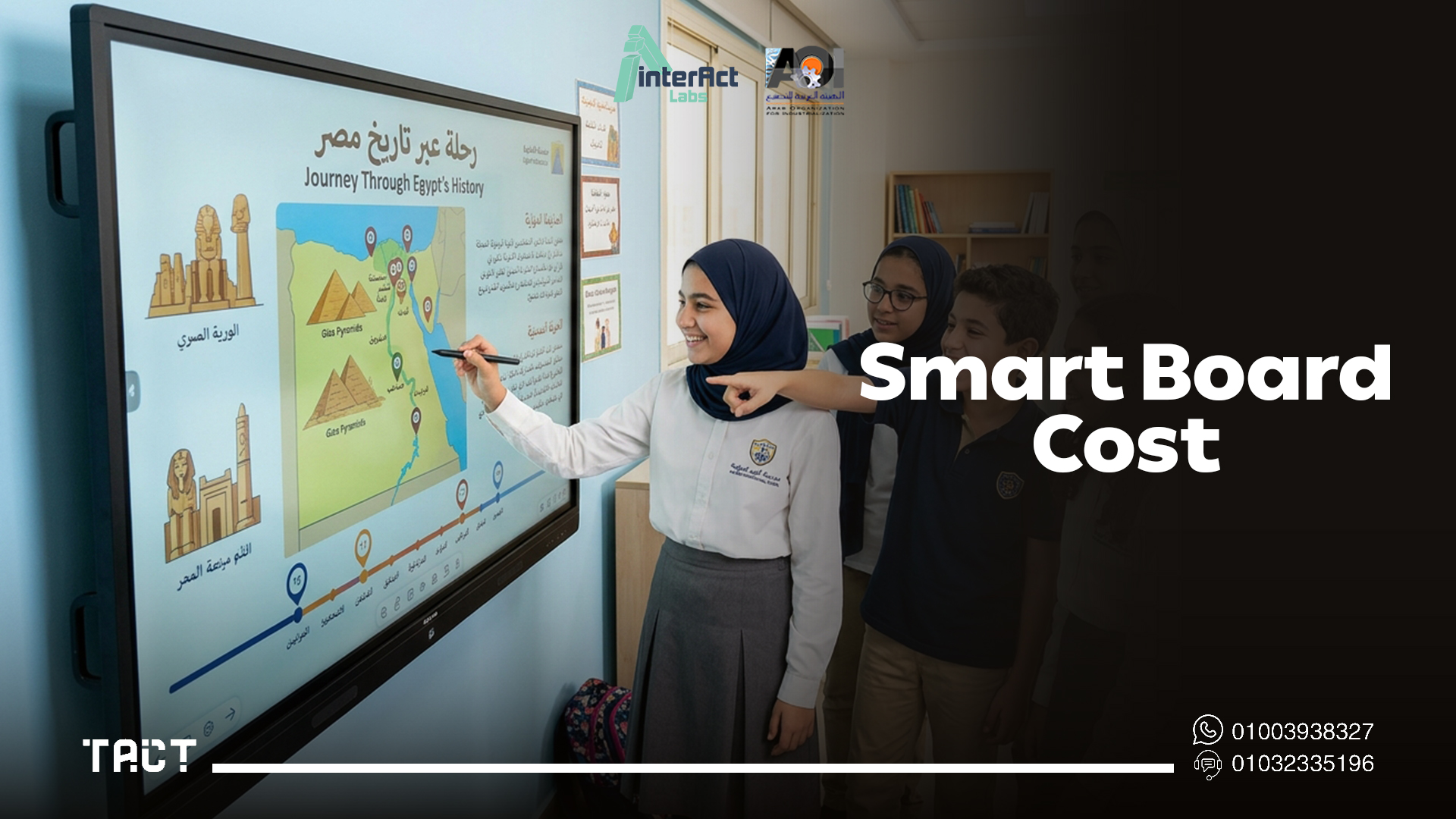
Most schools focus on the sticker price when evaluating smart board cost. That's the wrong number to look at.
The purchase price is just the beginning. What actually determines whether a smart board investment makes sense — or quietly drains a school budget over time — is the total cost of ownership: everything spent on the device from day one through years of daily classroom use.
This article breaks down the complete smart board cost structure, where the hidden expenses come from, and how the Tact device eliminates most of them by design.
Exploring smarter ways to equip your classrooms? Visit Interact Labs and see what's possible within your actual budget.
Why Smart Board Cost Is More Than the Purchase Price

When a school budgets for a smart board, the line item usually reflects one number: the device price. But the real smart board cost over a three-to-five-year period looks very different once all the components are accounted for.
Understanding this distinction is what separates a smart purchasing decision from an expensive one.
Installation and infrastructure costs
A full smart board system doesn't arrive ready to use. Installation typically requires wall mounting, electrical work, and in some cases modifications to the classroom layout to accommodate wiring and positioning. For older school buildings — common across Egypt — this can mean significant preparation work before the device is even powered on.
These costs are paid upfront, before any educational value is delivered, and they vary significantly depending on the classroom's existing infrastructure. In schools with multiple floors or older electrical systems, installation costs alone can represent a meaningful portion of the total smart board budget.
Ongoing maintenance costs
Smart boards require regular maintenance to operate efficiently over time. This includes software updates, hardware servicing, troubleshooting touch calibration issues, and periodic technical inspections. Unlike a simple monitor that runs for years with minimal intervention, a full smart board system has enough components and software dependencies that maintenance is an ongoing budget line — not a one-time event.
For schools managing 10, 20, or 30 classrooms, these maintenance costs multiply quickly and become a predictable annual expense that wasn't always factored into the original purchasing decision.
Spare parts and repairs
With intensive daily classroom use, hardware failures happen. Touch units lose accuracy. Screens develop dead zones. Cables wear out. Proprietary components for imported or premium smart board brands are often expensive, sometimes hard to source locally in Egypt, and can leave a classroom offline for days or weeks while parts are ordered and installed.
Each repair event carries two costs: the parts and labor, and the lost classroom time during the outage. Neither shows up in the original purchase price.
Replacement cycles
Smart board technology evolves. A device purchased in 2020 may be functionally outdated by 2026 — incompatible with newer software, unsupported by the manufacturer, or simply unable to run the educational applications that teachers now rely on. Replacement cycles force schools to repeat the full investment — purchase, installation, and setup — every few years, compounding the total smart board cost significantly over time.
The True Smart Board Cost Over Five Years
When all components are included — purchase, installation, annual maintenance, occasional repairs, and eventual replacement — the five-year smart board cost per classroom is substantially higher than the initial sticker price suggests.
For schools attempting to equip multiple classrooms simultaneously, this total cost structure creates a hard ceiling on how many rooms can realistically be modernized within a fixed budget. The result is a familiar situation: a handful of equipped classrooms, and the majority of the school still running on traditional tools.
This is the real cost problem — not the price of one smart board, but the structural inability to scale across a full school at a sustainable cost per room.
How the Tact Device Reframes Smart Board Cost

The Tact device doesn't compete with smart boards on features. It competes on cost structure — and that's a fundamentally different conversation.
Rather than replacing existing classroom screens with new hardware, the Tact device adds interactive functionality to whatever the school already has. A monitor, a projector, any flat display surface — all become fully interactive with the Tact device installed. The hardware investment the school already made continues to deliver value instead of being discarded.
See the Tact device in detail — configurations, specifications, and pricing for Egyptian schools.
One-time cost, no ongoing expenses
The Tact device is purchased once. There are no monthly subscription fees, no annual maintenance contracts, and no proprietary components that require expensive replacements. The cost is paid at acquisition and doesn't recur.
This single structural difference changes the total cost of ownership calculation dramatically. Over five years, the cost per classroom with the Tact device remains close to the original purchase price — while a traditional smart board system accumulates maintenance, repairs, and eventually replacement costs on top of the initial investment.
No installation infrastructure required
The device mounts above or beside the existing screen in minutes — no electrical work, no wall modifications, no professional installation team required. A teacher can complete the setup independently without IT support or classroom disruption.
For schools in older buildings where installation costs for full smart board systems would be significant, this difference alone can represent thousands of pounds saved per classroom.
Compatible with existing equipment
Schools don't discard what they already have. Every projector, monitor, or display screen in the building becomes a candidate for interactive use. The investment the school made in its existing hardware is extended rather than replaced — and the budget that would have gone toward new hardware goes further as a result.
Portable across classrooms
One Tact device can serve multiple rooms. Instead of purchasing a separate unit for every classroom, schools can start with a smaller number of devices and rotate them based on scheduling — or expand gradually as budget allows. This flexibility is structurally impossible with fixed-installation smart board systems.
Minimal maintenance requirements
The Tact device's design relies on the school's existing screen for display — meaning there are no display components within the device itself to fail, no proprietary touch hardware to service, and no complex software system to maintain. Day-to-day operation is straightforward, and the maintenance burden is a fraction of what a full smart board system requires.
Smart Board Cost: What Schools Actually Save
The savings with the Tact device operate at two levels.
The first is the per-classroom cost. Equipping a classroom with the Tact device costs significantly less upfront than purchasing a full smart board — with schools reporting total setup savings of up to 80% compared to traditional systems.
The second is the multiplication effect. A school that saves 80% per classroom can equip five times as many rooms with the same budget. For an institution trying to modernize comprehensively — not just in selected classrooms — this is the number that matters.
A budget sufficient for three or four smart board installations can instead cover an entire school floor using the Tact device. Over five years, with no recurring maintenance costs added to the equation, the cumulative saving per institution is substantial.
Frequently Asked Questions — Smart Board Cost
Q: Does the Tact device have any recurring costs after purchase? No. The device is a one-time purchase with no subscription fees, maintenance contracts, or mandatory update costs. Operational expenses after purchase are minimal.
Q: What if the existing school screen breaks down — does the Tact device become unusable? The Tact device works with any compatible replacement screen. If the original display is replaced, the device simply mounts to the new one — no additional purchase required.
Q: How does the Tact device hold up under daily classroom use? The device is designed for high-frequency educational environments. Interact Labs provides local technical support and locally available components in Egypt, so any issues are resolved quickly without long waiting periods.
Q: Is the Tact device compatible with all screen types? It works with standard monitors, projectors, and flat display surfaces. For specific compatibility questions, Interact Labs' technical team can confirm compatibility before purchase.
Q: What is the actual smart board cost comparison — Tact device versus a full smart board system? Exact pricing depends on screen size and configuration. Visit the Interact Labs shop for current pricing — the comparison to full smart board system costs becomes immediately clear once the numbers are reviewed side by side.
Q: Can the Tact device be used at the university level, or is it only for schools? The device works across all educational levels — primary, secondary, and university — as well as corporate training environments. The cost advantages apply equally across all these contexts.
Final Word: Smart Board Cost in 2026
Smart board cost is not a single number — it's a five-year financial commitment that includes purchase, installation, maintenance, repairs, and eventual replacement. When schools evaluate it that way, the decision framework changes entirely.
The Tact device doesn't just reduce the upfront cost. It changes the cost structure — eliminating most of the ongoing expenses that make traditional smart board systems financially unsustainable at scale. For Egyptian schools that need to modernize more than a few classrooms, that structural difference is what makes comprehensive digital transformation actually achievable.
Ready to see what smart board cost looks like when the hidden expenses are removed? Explore the Tact device on Interact Labs and find out what your budget can actually cover.


