

This article was prepared by the content team at Interact Labs, the Egyptian company specialized in developing interactive digital education solutions since it was founded in 2019 in Cairo, drawing on direct experience supplying and supporting the TACT device for schools, universities and training centers across the Egyptian market.
Last updated: July 2026
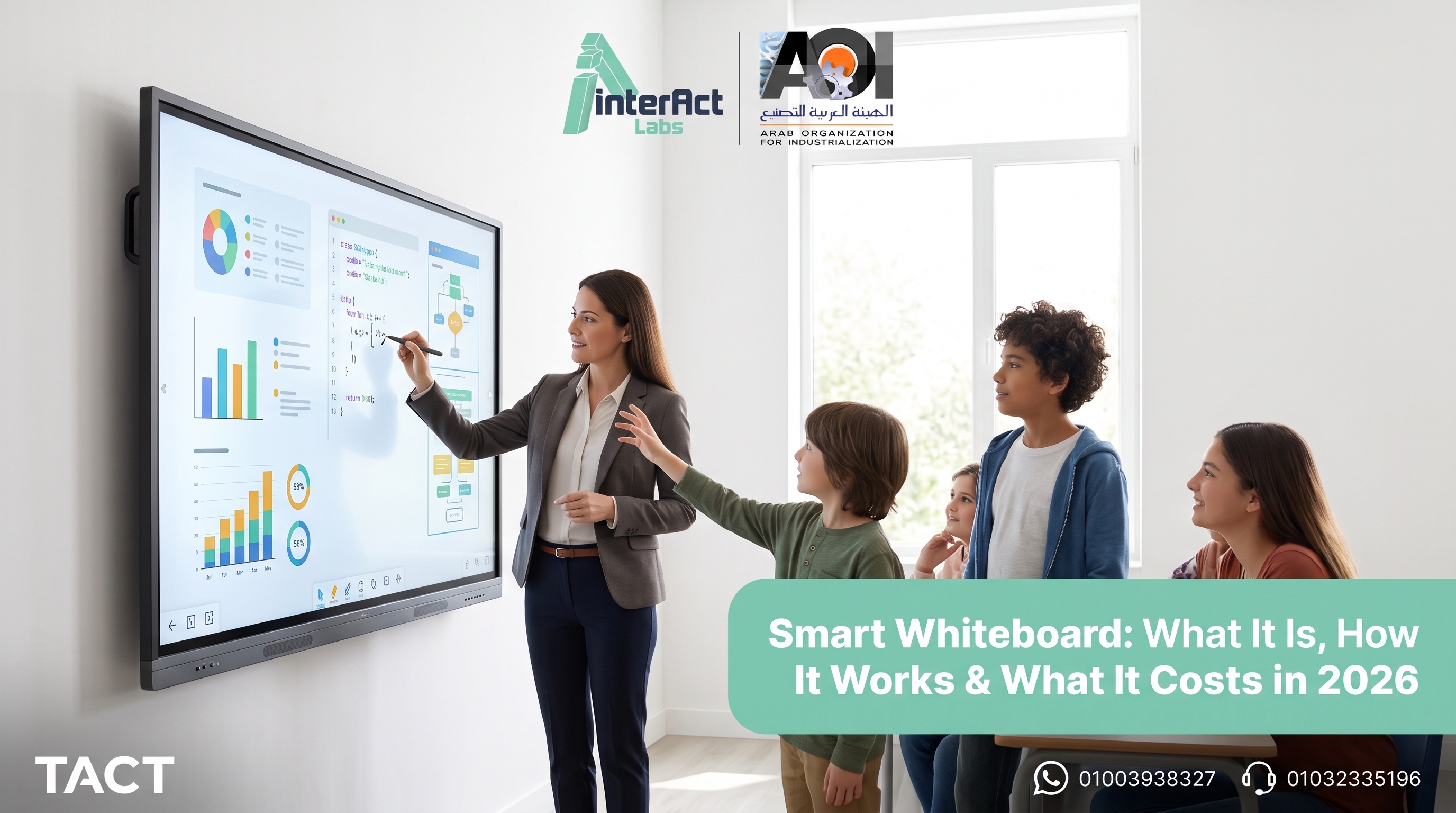
A smart whiteboard turns a plain wall or screen into a touch interactive teaching surface, letting a teacher write, draw and control software with a finger or a pen instead of a mouse. Some smart whiteboards are large dedicated panels, while others are small devices that add touch to a screen or projector a school already owns. This guide explains how a smart whiteboard works, what changes the price, and how a TACT device from Interact Labs compares to a traditional wall panel as an interactive whiteboard for the classroom in Egypt.
A smart whiteboard is a touch interactive display used for teaching, presenting or collaborating, built either as a dedicated panel or as a device that adds touch to an existing screen. Cost depends on touch technology, screen size, software compatibility and support. A device based option such as TACT can deliver the same core functionality as a full dedicated panel at a fraction of the price.
What is a smart whiteboard
A smart whiteboard is a display or surface that responds to touch, letting users write, draw, move objects and control connected software directly on the screen. It replaces a marker and a static board with a digital canvas that saves, shares and connects to a computer. You will also see it called a smart interactive whiteboard or a smart interactive board, but all three names describe the same thing: a display you control by touch rather than with a mouse.
The category covers two different products. A dedicated smart whiteboard panel is a large all in one touch display with its own screen, processor and software, usually mounted on a wall or stand. A device based smart whiteboard, such as TACT, is a small accessory that turns any existing screen, projector or television into a touch surface without replacing the display itself.
Interact Labs, an Egyptian company founded in 2019 in Cairo, builds the TACT device around this second approach, so a school does not need to buy a new screen to get touch interaction. If you want a broader look at interactive screen form factors before focusing on the smart whiteboard specifically, our complete interactive screen guide covers that in detail.
Discover the full range of smart whiteboard solutions from Interact Labs, start here
How a smart whiteboard works in the classroom
A smart whiteboard tracks touch using one of three technologies. Infrared systems detect a finger or pen by interrupting a grid of light beams across the surface, and keep working even when the user is wearing a glove or using any non conductive object. Resistive systems register pressure between two thin flexible layers, which is cheaper but tends to lose sensitivity over time from the constant friction between the layers. Capacitive systems, common in phones and tablets, sense the electrical signal from a finger directly, giving high precision but not working with an ordinary pen or a gloved hand.
Once touch is detected, the smart whiteboard sends the coordinates to a connected computer, the same way a mouse would. The computer runs the actual software, whether that is a slide deck, a browser or an annotation app, and the whiteboard becomes the pointing device and the display at the same time.
A device based solution like TACT works the same way, except the touch sensor connects to an existing screen or sits in front of a projected image, so the classroom keeps the display it already owns. TACT uses infrared sensing specifically, a deliberate choice because it works well with any display surface, whether an LED screen or a projected image, unlike capacitive sensing which needs a dedicated glass surface.
Smart whiteboard vs a traditional whiteboard vs a device based solution
Here is how a traditional whiteboard, a dedicated smart whiteboard panel and a device based solution compare on the factors that matter most for a classroom purchase. A traditional whiteboard has no touch interaction at all, costs little and needs no installation, but it does not work with any software. A dedicated smart whiteboard panel has touch built into the display from the factory, costs the most, needs wall mounting and wiring, often ships with vendor specific software, and stays fixed in place. A device based solution like TACT adds touch to your existing screen at a low to moderate cost, installs in minutes with no wall work, works with the software you already run, and moves easily between rooms.
Four things to check before you buy a smart whiteboard
Beyond the general definition, four practical factors decide whether a smart whiteboard fits a specific classroom or training room: touch technology, screen and room fit, software compatibility, and total cost and support.
Touch technology affects how the surface feels to use and how well it performs in a brightly lit room, which matters in many Egyptian classrooms that take strong natural light through most of the day. Screen and room fit determines whether students at the back row can see clearly, and a 65 inch display is often the practical minimum for a normal classroom of more than 20 students. Software compatibility decides whether existing lesson files and apps still work without conversion. Total cost and support determine what happens after the sale, not just the price on the invoice.
A report from the Organisation for Economic Co-operation and Development on international experiences with interactive whiteboards found that the value of the technology depends heavily on ongoing support and integration into daily teaching, not just the initial purchase (OECD, 2013).
Warranty and maintenance, the question schools forget to ask
Many schools focus on the purchase price and forget to ask about warranty length and maintenance procedures, which is a mistake because any electronic device is prone to faults after a period of use. Ask exactly how long the warranty runs, whether it covers parts and labor together, and whether a temporary replacement is available if the unit needs a lengthy repair. Solutions backed by an Egyptian company that handles support locally, like TACT, generally offer a faster response time than imported panels that require contacting a foreign agent for every technical issue.
What affects the cost of a smart whiteboard in Egypt
Price is rarely just the sticker price of the hardware. Shipping, customs duties and currency conversion can add significantly to an imported dedicated panel, while a locally supplied device based solution avoids most of that overhead.
The 2023 Global Education Monitoring Report from UNESCO notes that technology in education only delivers value when it is matched to real classroom needs and paired with proper support, rather than adopted for its own sake (UNESCO, 2023).
Egypt's Ministry of Education has been expanding technology supported learning, including its participation in the UNESCO organized Digital Learning Week, signaling continued investment in classroom technology across the country (Ministry of Education, 2024).
For a full breakdown of what a complete classroom setup costs, see our smart classroom cost guide for Egypt. Individual teachers comparing options for a single room can also read our smart board pricing guide for teachers.
TACT, a smart whiteboard alternative designed and supported in Egypt
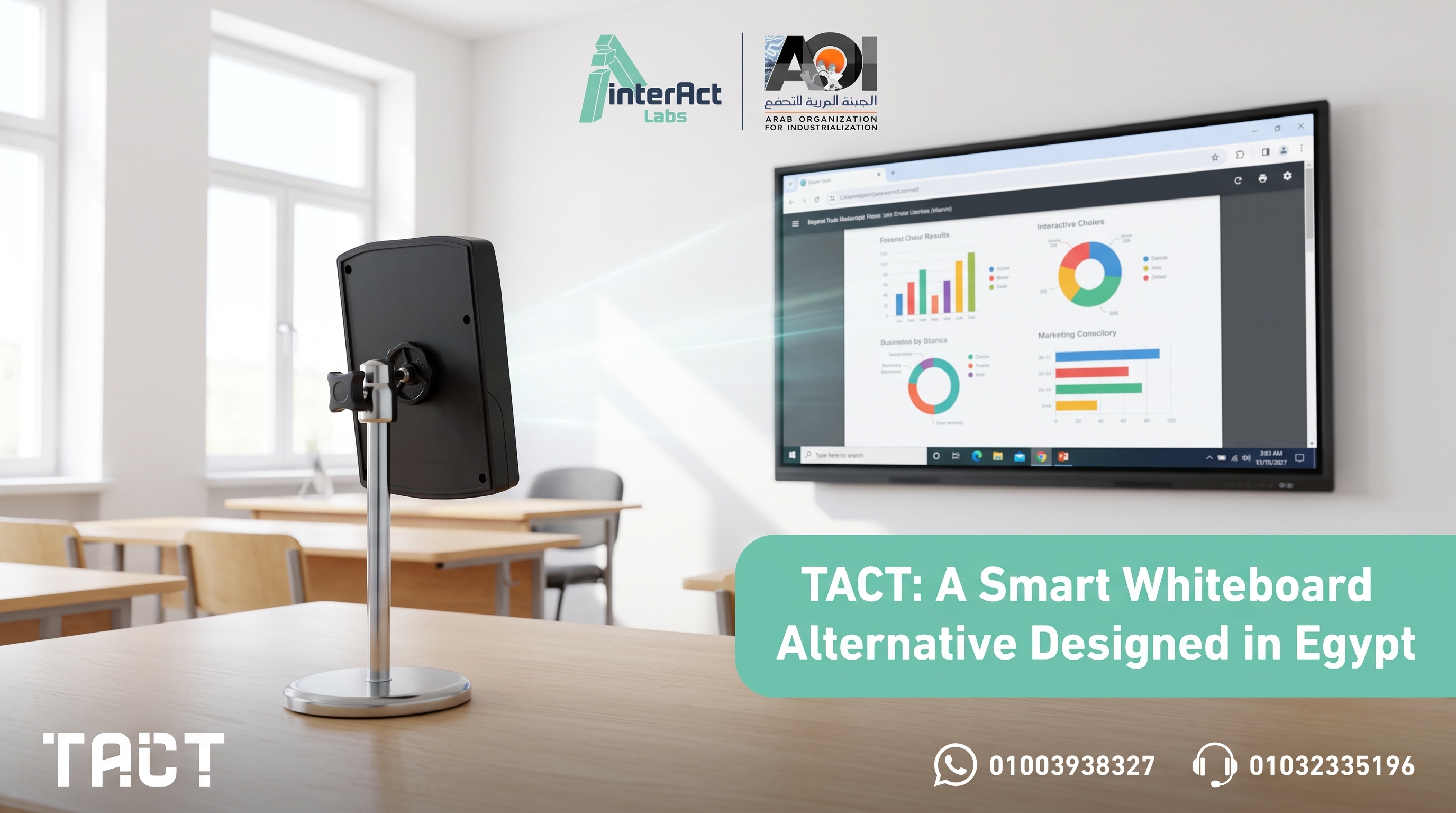
Instead of buying a fixed panel, the TACT device from Interact Labs connects to a screen, television or projector already in the room and turns it into a fully interactive surface within minutes. It supports up to four simultaneous users, works with existing software, and covers displays up to 150 inches.
TACT is priced at 7,980 EGP, reduced from 10,000 EGP, with VAT included and installment options available. Prices and offers are subject to change, so it is best to confirm the current price with the sales team before buying. Even allowing for price changes, this remains a fraction of what a dedicated imported panel typically costs once shipping and installation are added.
Because Interact Labs is based in Cairo, replacement parts, technical support and training do not depend on an international shipping schedule. For the full specification and setup details, read our complete guide to the TACT device.
Schools that have already experienced the downsides of a fixed installation can compare notes in our guide to the disadvantages of traditional smart boards.
How to choose the right smart whiteboard for your classroom
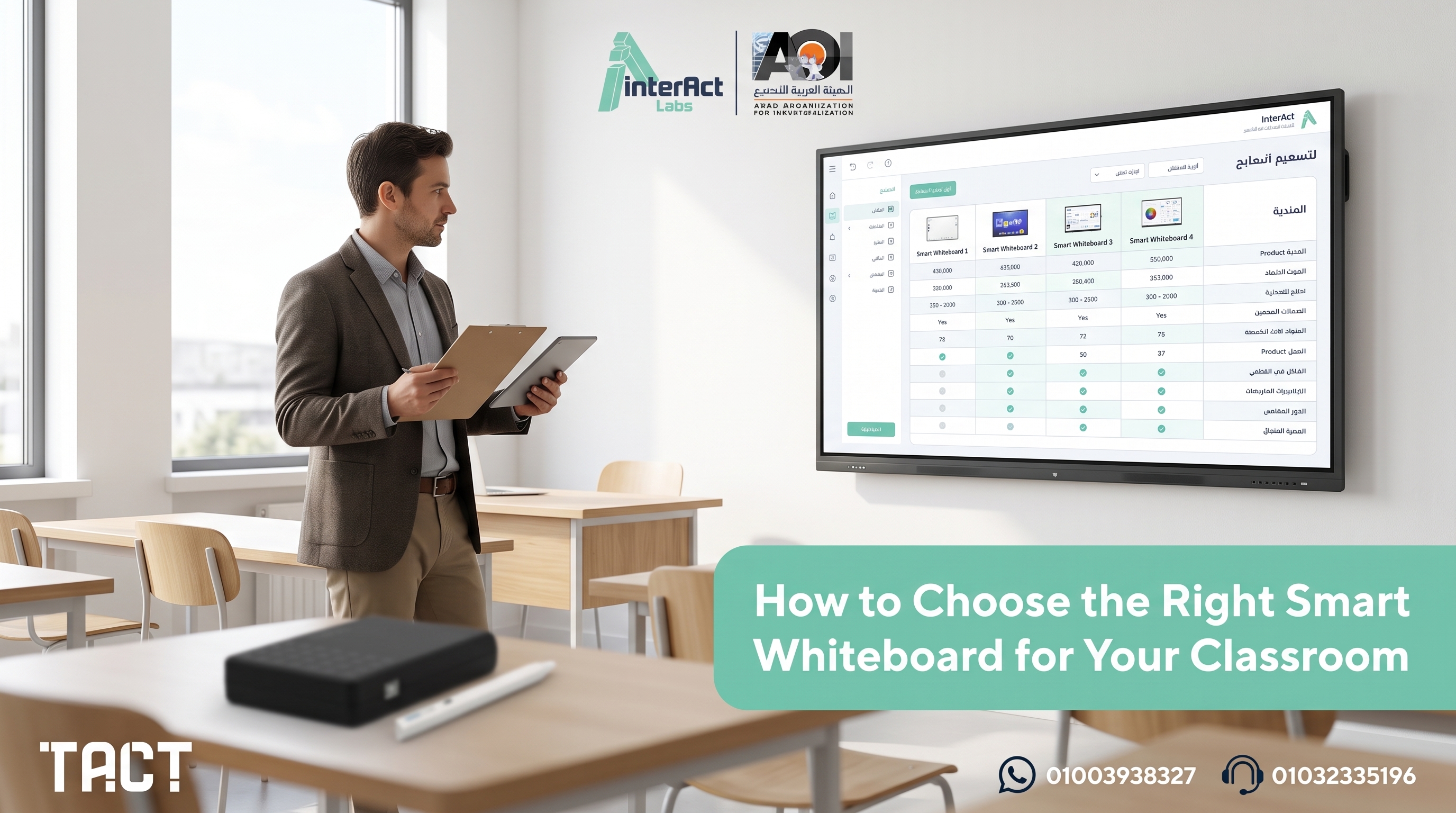
Match the touch technology to your room. Infrared and capacitive sensors generally perform better in brightly lit rooms than older resistive designs.
Measure your screen against your room size. A display that is too small will not be readable from the back row.
Confirm the software you already use still works. Check that existing lesson files, browsers and teaching apps run without conversion.
Ask for a landed cost, not just a list price. Include shipping, customs, installation and the first year of support in the comparison.
Check the support response time before you commit. Find out how quickly a technician can reach the site if the equipment needs service.
Ask about warranty length and terms in detail. A one year warranty is very different from a three year one, and that gap is worth weighing in the comparison.
Browse the full TACT range in the shop, shop now
Key takeaways
A smart whiteboard adds touch interaction to teaching, either as a dedicated panel or as a device that upgrades a screen already in the room.
Touch technology, screen size, software compatibility and total cost are the four factors that decide the right fit.
A device based solution such as TACT can deliver the same core functionality as a full dedicated panel at a fraction of the price.
Local support, spare parts availability and warranty length matter as much as the hardware once the unit is installed.
Pricing quoted in Egyptian pounds with VAT included avoids unexpected costs at checkout, but always confirm the current price before buying.
Frequently asked questions about smart whiteboards
What is a smart whiteboard used for? A smart whiteboard is used for interactive teaching, presentations and team collaboration. It lets a teacher or presenter write, annotate slides and control software directly on the display, then save or share the session afterward instead of erasing it like a regular whiteboard.
What is the difference between a smart whiteboard and an interactive whiteboard? The terms are generally used interchangeably. Both describe a touch enabled display used for teaching or presenting. Some brands use smart whiteboard for a dedicated panel and interactive whiteboard for a projector based setup, but the core function is the same.
How does a smart whiteboard work without any installation? A device based smart whiteboard, such as TACT, connects to a screen, television or projected image and tracks touch directly, so there is no wall mounting or wiring. It connects to a computer the same way a mouse does.
Is a smart whiteboard the same thing as a smart board? Yes, smart whiteboard and smart board generally refer to the same category of touch interactive display used in classrooms and meeting rooms, though smart board is sometimes used as a brand specific term by certain manufacturers.
How much does a smart whiteboard cost in Egypt? Cost varies widely by type. A dedicated imported panel can run into tens of thousands of Egyptian pounds once shipping and installation are included, while a device based solution such as TACT costs far less, with VAT and installments available. It is best to confirm the current price directly.
Can a smart whiteboard work with a normal projector or TV screen? Yes, a device based smart whiteboard such as TACT is designed specifically to add touch interaction to a projector image or an existing television or monitor, so a school does not need to replace the display it already owns.
How many people can use a smart whiteboard at the same time? This depends on the product. The TACT device from Interact Labs supports up to four simultaneous users on the same screen, which suits group work and paired activities in a classroom setting.
Do smart whiteboards need special software to run? A device based smart whiteboard generally works with software already installed on the connected computer, including browsers, slide decks and standard teaching apps, so schools do not need to buy or learn a new platform.
Is a device based smart whiteboard cheaper than a full dedicated panel? In most cases yes, because a device based solution reuses a screen, television or projector the school already owns instead of requiring a brand new all in one panel, which lowers both the purchase price and the installation cost.
Does a smart whiteboard scratch or break like a normal screen? A dedicated panel has a glass surface that can scratch or crack under a hard knock, which is a concern in classrooms with young children. A device based solution like TACT adds no new breakable surface, which significantly lowers the risk of physical damage to the investment.
Does Interact Labs support schools outside Cairo? Yes, Interact Labs supplies and supports schools, universities and training centers across Egypt, not only in Cairo, with technical support and spare parts handled locally rather than through international shipping.
Conclusion and next step
Choosing a smart whiteboard is not just a hardware decision, it is a decision about installation time, software compatibility, warranty, and how quickly support arrives if something goes wrong. A dedicated panel can work well for a purpose built room, but a device based solution such as TACT gives a school the same interactive teaching capability at a lower cost and without replacing existing screens.
If you are planning to add interactive teaching to a classroom, training room or meeting space, the Interact Labs team can walk you through the options that fit your budget and room setup.
Try the TACT device yourself and get a free consultation at the current price, order now
The Interact Labs Team
Specialized educational content on interactive display solutions and smart classrooms, backed by field experience since 2019 designing and supplying the TACT device for schools and institutions across Egypt and the Arab region.
Sources and references
Organisation for Economic Co-operation and Development, OECD, Learning from International Experiences with Interactive Whiteboards, 2013
United Nations Educational, Scientific and Cultural Organization, UNESCO, Global Education Monitoring Report, Technology in Education, 2023
Egyptian Ministry of Education, participation in the UNESCO organized Digital Learning Week, 2024


